
Does Iran have nukes?
The current state of a cease-fire, where ‘tit for tat’ reprisals are a continual threat to the security of Iran, is draining, with Iran continually living under the threat of attack.

THE ongoing war between Iran, Israel and the United States is wearing patience thin in Tehran.
The current state of a cease-fire, where ‘tit for tat’ reprisals are a continual threat to the security of Iran, is draining, with Iran continually living under the threat of attack.
Information has surfaced from an alleged telephone conversation between the president of Iran, Masoud Pezeshklan and the prime minister of Pakistan, Shehbaz Sharif, around May 28 that Iran was proposing a demonstration in the Iranian desert of the country’s nuclear capability with a non-combative explosive demonstration.
There are different versions as to how the United States became aware.
Some are saying that US intelligence intercepted the call, while others are saying that Secretary of State Marco Rubio was informed by the Iranian foreign minister Abbas Araghchi, on May 29.
This information contradicts the Iranian policy of no nuclear weapons, originating from a Fatwa proclaimed by the former supreme leader of Iran, Ayatollah Ali Khamenai many years ago.
There is no formal indication that this Fatwa, made in the mid-1990s, has been changed by the new supreme leader, Mojtaba Khamenei. However, the conditions since the mid-1990s have drastically changed, where Iran is now under existential threat by Israel and the United States.
Contemporary history has shown that nations like North Korea have been treated very differently from countries like Libya and Iraq that didn’t have nuclear weapons by the United States.
Consequently, it may be logical thinking that Iran possessing nuclear weapons would result in a different approach by attackers.
Israel’s Prime Minister Benjamin Netanyahu has been constantly saying that Iran is on the verge of possessing nuclear weapons.
However, Western intelligence has generally believed that Iran doesn’t possess nuclear weapons.
Iran is a technologically sophisticated country, as the current war has demonstrated.
It is very conceivable that, although a Fatwa forbade Iran from possessing nuclear weapons, the armed forces had processed enough uranium for 9 or 10 warheads, while the actual bombs without the enriched uranium components were stored deep in underground bunkers in another part of the country.
Some nuclear experts believe this is very plausible, although there is no public evidence of this.
Iran definitely has the knowledge, scientific aptitude and ability to do this.
In addition, it’s believed that Iran has long been working together with both Pakistan and North Korea on nuclear weapon technology.
The other possibility is that Iran has obtained several nuclear warheads from either North Korea or Pakistan.
It is known if Pakistan may have already transferred some nuclear weapons to Saudi Arabia under Pakistani control.
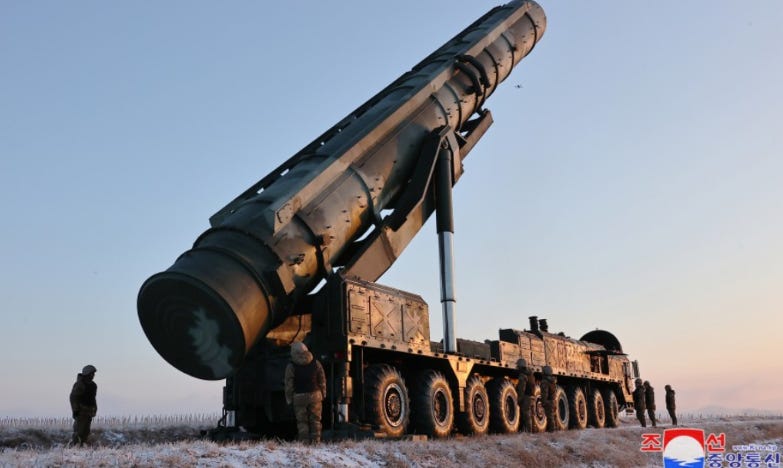
Image from https://www.38north.org/2023
It should be noted that Iran has already received the Hwasong-18 ICBM intercontinental missiles from North Korea capable of reaching the United States.
Together, these ICBMs with nuclear warheads could be devastating to the United States.
Iran has already proved it has hit Israel with missiles without much resistance today.
What would be very concerning to Israel is that a nuclear strike on Iran would not be as devastating as an Iranian nuclear attack on Israel, because Iran is a very large country, and Israel has a very small land mass.
This means that Iran could annihilate Israel with nuclear weapons without being annihilated itself.
Strategically, this means that the United States and Israel cannot ‘bully’ Iran and expect to escape severe consequences.
The US objective of preventing Iran from acquiring nuclear weapons has already failed, with US President Donald Trump being humiliated.
It’s now very unlikely that Iran will continue any more negotiations with the United States, and Israel will be forced to withdraw from Lebanon as well.
If US provocations don’t cease, then it is most likely that Iran would detonate a nuclear device to prove its possession.
If Iran proceeds, then it will be understood that Iran has more than just a single nuclear bomb at its disposal.
This may help Iran finish the war that continues to linger in a ‘cease-fire’ limbo.
Iran proving it possesses a nuclear weapon capability will gravely dent the pride of the United States and lead the world more quickly into a multi-polar order. – June 4, 2026
Your donations are vital to keep some independent journalism alive.
Just click here or goto https://buymeacoffee.com/murrayhunter
Wise: https://wise.com/pay/me/murrayvictorh
PayPal: @MurrayHunter733
Subscribe Below
The Illusion of Strength: How Iran Rewrote the Rules of Power
It is an ancient truth in statecraft: one negotiates only from a position of strength. Yet hubris has a way of blinding even the most formidable powers. In the summer of 2025, both Israeli intelligence and the American defense establishment gazed upon Iran and saw a hollowed-out regime, a spent force ripe for demolition. A handful of precision strikes, they believed, would shatter its military facade and ignite the internal rebellion long nurtured by tens of millions of dollars funneled to exile networks and would-be restorers of the Pahlavi throne. Mossad’s legendary networks and the CIA’s vast apparatus were in place. Victory seemed not merely probable, but inevitable.
What followed instead was a brutal education in the limits of perception.
For over two months, the world watched as the two most technologically advanced militaries in the Western pantheon , battle-hardened, lavishly equipped, and backed by the collective weight of NATO , found themselves locked in a grinding, asymmetric contest against an adversary they had dismissed as backward and broken.
Iran’s counterstrikes came with unexpected ferocity, strategic depth, and disciplined resolve. Missile barrages, drone swarms, and meticulously prepared defenses exposed the fragility of assumptions that had hardened into dogma. Israel’s military reputation, once seemingly unassailable, emerged battered. America’s aura of dominance frayed. Patience and strategic silence, it turned out, had cloaked formidable advances.
Unlike its adversaries, Iran invested little in propaganda. It studied. It adapted. It absorbed the lessons of Lebanon, Syria, and America’s own post-9/11 wars. When the moment came, it struck at times and places of its own choosing, the classic logic of asymmetric warfare elevated to a national doctrine. The result was not merely survival, but a demonstration that quietly brought the United States to the negotiating table with its hand forced.
The Nuclear Shadow
Beneath the conventional fighting lay a deeper, darker truth. For years, the United States and Israel suspected that North Korea’s nuclear program had received shadowy third-party patronage perhaps from China or Syria. They were mistaken. The true partner was Iran. What Western analysts had dismissed as an “Islamic” regime incapable of serious scientific endeavor had quietly forged a sophisticated partnership with the cash-starved Hermit Kingdom. Persians, after all, are heirs to an Indo-European civilization with millennia of intellectual tradition, a fact too often obscured by reductive cultural narratives.
Repeated assassinations of Iranian scientists by Israeli operatives had taught Tehran a harsh lesson. It responded by building a secure, opaque scientific ecosystem. The fruits of that patience are now impossible to ignore. Credible assessments place Iran in possession of between eight and twelve nuclear devices, with yields ranging from 10 to 100 kilotons. A single well-placed 100-kiloton warhead would, given Israel’s compact geography, fundamentally alter the strategic map of the Middle East.
Meir Dagan, the late and widely respected former Mossad director, had warned Benjamin Netanyahu against this path. Iran, he argued, would accelerate its nuclear program under pressure, and might already possess a testable device developed through simulation. Events appear to have vindicated that caution.
The New Realities
Donald Trump’s public declarations of Iranian collapse now read like echoes of Mark Twain’s famous quip: “The reports of my death have been greatly exaggerated.” Behind the rhetoric, American policy has shifted. The Gulf of Hormuz, long a latent vulnerability, became an active theater of pressure as Iran demonstrated its ability to disrupt global energy flows.
Traditional Gulf allies began hedging. NATO’s relevance has been called into question more profoundly than at any point since its founding. The old Western alliance structure, built for a different era, is visibly fracturing.
The arithmetic of modern warfare has turned cruel. Israel and the United States face the punishing economics of high-end interceptors and precision munitions against Iran’s cheaper, massed, and increasingly effective missile and drone barrages. Replenishment is slow, expensive, and politically fraught. Iran’s swarms have overwhelmed even the most sophisticated defenses, exposing the asymmetry not just in tactics, but in sustainability. Another dimension of the Mao Wave.
Israel now finds itself in a position reminiscent of 1973, yet far more constrained. Then, the nuclear option loomed as a last resort. Today, the threat is mutual and potentially terminal. A nuclear exchange, whether first or second strike, would likely end the Jewish state as a viable entity, given the disparity in land mass and strategic depth. Iran’s calculated ambiguity about its nuclear status has become its strongest deterrent.
The Black Knight of Monty Python fame, insisting it is merely a flesh wound while bleeding out, offers an uncomfortable parallel. Should Israel pause for any reason, the perception of weakness could ignite long-simmering regional dynamics: popular fervor across the Arab world, precarious regimes vulnerable to coups or Islamist revolutions, and the specter of Shia ascendancy in the Gulf. Yet the alternative, continued escalation, risks catastrophe.
History rarely grants clean endings. What it does offer is this sobering reminder: power is never static. It hides in patience, in preparation, in the willingness to learn from one’s enemies while they underestimate you. Iran has reminded the world that strength is not always loudest in the moment of bravado. Sometimes it whispers, and waits.