

KL Pundit
On Saturday, March 22, 2026, Robert Mueller died at the age of eighty-one. He had Parkinson’s disease. Mueller was a Princeton graduate who joined the Marine Corps, fought in Vietnam, earned a Bronze Star and a Purple Heart, and spent the rest of his career in public service — including twelve years as director of the FBI. He led the bureau through the aftermath of September 11. In 2017, he was appointed special counsel to investigate Russian interference in the 2016 presidential election.
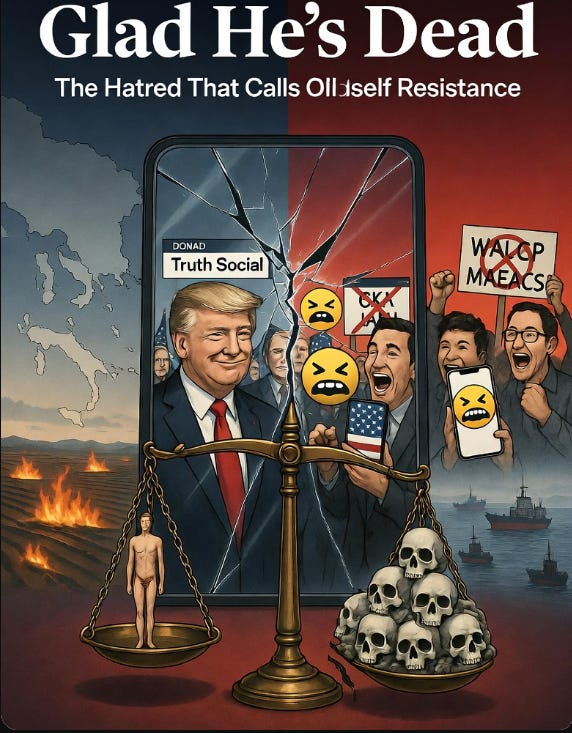
Minutes after the news broke, the President of the United States posted on Truth Social: “Robert Mueller just died. Good, I’m glad he’s dead. He can no longer hurt innocent people!”
Treasury Secretary Scott Bessent was given three separate opportunities on NBC’s Meet the Press to condemn the remark. He declined all three. Instead, he asked the American public for “empathy” — not for Mueller’s family, but for Donald Trump. Fox News mentioned Mueller’s death six times on air over the weekend without once quoting the president’s celebration of it.
This piece starts with Trump’s words because they are indefensible. No caveat, no context, no political framing changes the fact that the President of the United States publicly celebrated the death of an eighty-one-year-old decorated veteran because that man had once investigated him.
But this piece is not about Donald Trump. He is the trigger. He is not the subject.
The War That Cannot Be Defended
Before this piece turns its attention to Malaysia, it needs to do something that most Malaysian commentators who criticize anti-American sentiment never bother to do: criticize America.
The United States and Israel launched a joint military attack on Iran on February 28, 2026. The attack came during active indirect nuclear negotiations between Washington and Tehran — a violation of the most basic diplomatic principle that you do not bomb a country you are talking to. There was no congressional declaration of war. No authorization for the use of military force specific to Iran. War powers resolutions have been introduced in both chambers of Congress to challenge the legality of the operation. The legal basis for this war is, at best, contested. At worst, it does not exist.
The opening strikes killed Iran’s Supreme Leader, Ali Khamenei. Subsequent strikes assassinated Ali Larijani, secretary of Iran’s Supreme National Security Council. The Assembly of Experts was bombed while in session. Parliament was struck. The state broadcaster’s headquarters was destroyed. The stated goal of the operation, confirmed by both American and Israeli officials, is regime change.
The humanitarian cost is catastrophic. At least eighteen hospitals and health facilities have been hit, according to the World Health Organization. A strike on an elementary girls’ school in the city of Minab killed more than 170 people, most of them children. Tehran is a ghost town. Schools are closed. Prisoners in Evin Prison are getting limited bread and water. The conflict has escalated across the region — into Lebanon, Iraq, and Syria. Iranian counter-strikes have hit Israel, the Gulf states, and Kuwait’s international airport. The Strait of Hormuz is paralyzed, with 2,000 vessels and 20,000 seafarers stranded. Oil has surged past $112 a barrel.
This war is being waged by a reckless American president driven by personal vendetta and ideological obsession, in coordination with an Israeli prime minister whose political survival depends on permanent conflict. Neither leader has a coherent plan for what comes after. The Trump administration’s own officials have offered contradictory justifications — nuclear prevention, resource control, pre-emption, regime change — suggesting that the strategic rationale is being invented after the fact to justify a decision already taken.
The war in Iran is illegal. It is immoral. It is a catastrophe for the Iranian people, for regional stability, and for the international order. The suffering it has caused — and will continue to cause — is real, documented, and indefensible.
And yet.
This war shares features with classical imperialism — asymmetric power, disregard for sovereignty, regime change imposed from outside — but it does not follow the old imperial pattern. There is no intention to colonize Iranian territory. There is no civilizing mission, no ‘white man’s burden’ rhetoric. The old empires wanted to govern the territories they conquered. Trump and Netanyahu want to destroy Iran’s capacity and walk away. This is not imperialism in the classical sense. It is something worse: destruction without responsibility. Ruination without reconstruction. The imperial power that doesn’t even bother to rule what it breaks.
I say all of this now so that what follows cannot be dismissed as Western apologism. I have just called this war illegal and immoral, and I stand by every word. But opposing this war does not permit anyone to celebrate the deaths of individual human beings. A war is a policy enacted by a state. A dead person is someone’s child, someone’s parent, someone who had a name before the politics took it away. The refusal to hold that distinction is the moral failure this piece names.
The Malaysian Mirror
In the days since Mueller’s death, social media in Malaysia has followed a predictable pattern. The Americans who condemned Trump’s post were mocked. Mueller himself was dismissed as a tool of empire. And underneath the commentary, a familiar sentiment surfaced — the quiet satisfaction that an American had died, dressed in the language of political resistance.
This is not new. It happens after every American military casualty in the Middle East. It happened during the Iraq and Afghanistan wars. It surfaces whenever an American political figure whom Malaysian social media has decided to despise is harmed, humiliated, or killed. The posts don’t engage with policy. They don’t analyze power structures. They don’t critique American foreign policy with the precision it requires. What they do is celebrate the fact that a human being is dead — and treat that death as a victory for their side.
And they call it anti-imperialism.
The Costume
Anti-imperialism is a serious intellectual tradition. It has a bibliography. Frantz Fanon wrote The Wretched of the Earth. Edward Said wrote Orientalism and Culture and Imperialism. Immanuel Wallerstein developed world-systems theory. Dependency theorists in Latin America produced a generation of scholarship on how imperial economic structures perpetuate inequality long after formal colonization ends. These scholars did the intellectual work. They built frameworks. They engaged with evidence. Their arguments can be debated and challenged — because they are arguments, not slogans.
The people celebrating American deaths on Malaysian social media have read none of them. They can’t distinguish between a realist critique of American hegemony and ethnic hatred of white Westerners. They don’t know what dependency theory is. They’ve never engaged with postcolonial scholarship beyond a slogan or a meme. What they have is a feeling — resentment toward white Western power — and a vocabulary borrowed from people who actually did the work. The vocabulary makes the feeling sound scholarly. It is not.
How do I know this is not anti-imperialism? Because of what they don’t do.
The Selectivity Test
If these people were genuinely opposed to imperialism — to the use of overwhelming power by one state to dominate, subjugate, or destroy another — their outrage would not be selective. It would apply to all empires, not just the white ones.
It doesn’t.
The Ottoman Empire systematically exterminated its Armenian Christian population between 1915 and 1916 — at least 664,000 and possibly over a million killed through massacre, forced marches, starvation, and organized brutality. Turkey denies it to this day. Silence from the anti-imperialists.
Imperial Japan committed the Nanjing Massacre in 1937 — estimates range from over 100,000 to as many as 300,000 Chinese civilians and prisoners of war murdered, tens of thousands of women raped. Japan ran a system of sexual slavery across occupied Asia, euphemistically called “comfort women.” Japan conducted biological warfare experiments on live prisoners in Unit 731. And Japan carried out the Sook Ching massacre right here — in Malaya and Singapore in 1942 — the systematic screening and execution of Chinese males by the Japanese military. This happened to the ancestors of people living in this country today. Where is the annual outrage? Where are the social media posts?
The Khmer Rouge killed between 1.5 and 2 million Cambodians between 1975 and 1979 — an Asian communist regime exterminating its own people, backed by China. The killing fields are not a metaphor. They are a place.
China’s Great Leap Forward killed between 15 and 55 million people through state-imposed famine. The Cultural Revolution destroyed lives, families, and an entire civilization’s cultural heritage. Tiananmen Square in 1989 was a military massacre of unarmed civilians demanding democratic reform. And today — right now — China is operating a system of mass internment, forced sterilization, and cultural erasure against the Uyghur Muslim population in Xinjiang. A non-white, non-Western state committing atrocities against a Muslim minority. The Malaysian anti-imperialists who weep for Palestine are silent.
Pakistan’s military killed an estimated 300,000 to 3 million people in Bangladesh in 1971 — a Muslim-majority army committing genocide against another Muslim-majority population. This was not a Western crime. This was not a white crime. This was Muslim killing Muslim, on a scale that dwarfs most of the conflicts that dominate Malaysian social media. Where is the commemorative hashtag?
Indonesia killed between 500,000 and 1 million people during the anti-communist purge of 1965–66, many of them ethnic Chinese. Indonesia then occupied East Timor from 1975 to 1999, killing an estimated 100,000 to 180,000 people. A Muslim-majority state brutalizing a Catholic population for a quarter of a century, next door to Malaysia. Where is the outrage?
Myanmar’s military has conducted what the United Nations has described as genocide against the Rohingya Muslim minority — ethnic cleansing carried out by a non-white, non-Western, Buddhist-majority state against Muslims. The Malaysian response was vocal — briefly — and then faded. It never generated the sustained, visceral fury that any American action in the Middle East reliably produces.
A non-white, non-Western power committed every single atrocity listed above. Not one involved the United States, Britain, or Europe. And the Malaysian voices that celebrate American deaths in the name of anti-imperialism have nothing to say about any of them.
The selectivity is the evidence. If the organizing principle were anti-imperialism, all of these would provoke outrage. If it were humanitarianism, all victims would be mourned equally. If it were Islamic solidarity, the Uyghurs and the Bangladeshis would generate the same fury as the Palestinians. They don’t. Because the organizing principle was never anti-imperialism, never humanitarianism, never Islamic solidarity. The organizing principle is anti-whiteness. Everything else — religion, anti-colonialism, Third World solidarity — is a smokescreen draped over racial hostility.
Anti-Semitism and the Racial Taxonomy
This connects directly to another feature of Malaysian public discourse that is rarely examined honestly: anti-semitism.
Malaysia has virtually no Jewish population. There is no history of Jewish-Malaysian conflict. There are no Jewish institutions in Malaysia. No Malaysian has been harmed by a Jewish person in any systematic or institutional way. And yet anti-semitism is widespread — not because it arises from lived experience, but because it has been imported wholesale from Middle Eastern political discourse and grafted onto the anti-Western framework.
In this framework, Jews function as honorary whites — proxies for Western power, the hidden hand behind American imperialism. The hatred is not based on experience. It is based on a racial taxonomy in which anyone associated with Western civilization is the enemy. Anti-semitism in Malaysia is not a separate phenomenon from the anti-Western bigotry this piece describes. It is a subcategory of it.
The clearest illustration remains Mahathir Mohamad’s speech to the Organization of Islamic Conference in Putrajaya in October 2003. “The Europeans killed six million Jews out of twelve million,” Mahathir told the leaders of fifty-seven Muslim-majority states. “But today, the Jews rule this world by proxy. They get others to fight and die for them.” The speech received a standing ovation. Not one of the fifty-seven delegations objected. In 2012, Mahathir said he was “glad to be labelled antisemitic.” In 2018, he disputed the death toll of the Holocaust on the BBC.
That was not a policy critique of Israel. It was a conspiracy theory rooted in racial categorization — the same categorization that makes anti-American sentiment in Malaysia not a political position but an identity.
The Colonialism Shield
Here is how the defense works. Whenever the selectivity is pointed out — whenever someone asks why Chinese imperialism, Japanese atrocities, or Muslim-on-Muslim genocide generates no comparable outrage — the answer is always the same: But the British colonized us. But the West exploited the Global South. But five hundred years of colonialism.
Colonialism happened. It was devastating. Its legacies are real and ongoing — in the structures of the Malaysian state, in the racial categories that still govern citizenship and opportunity, in the economic asymmetries between the Global North and South. None of that is in dispute.
But invoking colonialism in these contexts is not analytical. It is diversionary. It functions as a permanent moral credit that exempts the speaker from having to engage with present-day atrocities committed by non-white powers. “The British colonized us” becomes a get-out-of-jail-free card that lets you ignore China’s domination of Uyghur territory, Japan’s colonization of Korea and Southeast Asia, and Indonesia’s occupation of East Timor. The sins of colonialism are real — but they are being used as a shield, not as an analysis.
This is willful ignorance. It is selective amnesia. And it is a choice. The atrocities listed in this piece are not obscure historical footnotes. They are well-documented, widely taught, and readily accessible. The decision not to know about them — or not to care — follows a pattern: atrocities committed by white Westerners are memorized, cited, and weaponized. Atrocities committed by non-white powers are forgotten, minimized, or explained away. That is not an education gap. It is a moral position — one that sorts human suffering by the race of the perpetrator rather than the experience of the victim.
The Traditions They Betray
The irony is that the very traditions these people claim to inhabit explicitly prohibit what they are doing.
In Islam, respect for the dead is a religious obligation. The Prophet Muhammad’s conduct toward fallen enemies is well documented — he insisted on the dignified treatment of the dead, including those who had fought against him. Celebrating someone’s death is not an Islamic position. It is a violation of one.
In the Confucian tradition, reverence for the dead is foundational. Filial piety extends beyond the grave. The treatment of the deceased — including one’s enemies — reflects the moral character of the living, not the dead.
In the Buddhist tradition, compassion does not cease at death. The suffering of all beings — including those who caused harm — is met with compassion, not applause.
And in the secular humanist tradition, the principle is simple: the norms we set for how we treat the dead govern how we ourselves are treated. We are all, eventually, the dead. The dignity we extend or withhold now is the standard for our own future.
The person in Malaysia who celebrates an American death while invoking Islamic moral authority is in direct contradiction with their own tradition. The traditions are clear. The people invoking them are not practicing them.
What This Argument Is Not
I am not defending American foreign policy. I called the war in Iran illegal and immoral in this very piece, and I did so in terms that leave no room for ambiguity. American foreign policy has caused immeasurable suffering in the Middle East, in Latin America, and in Southeast Asia. That suffering is real, and its victims deserve recognition, justice, and accountability.
I am not arguing that criticism of the United States is illegitimate. It is not only legitimate — it is necessary. A world that cannot criticize the most powerful state on earth has surrendered its analytical capacity.
I am not denying that colonialism happened, that its legacies persist, or that the Global South has legitimate grievances against the historical conduct of Western powers.
What I am arguing is this: celebrating the death of an individual human being is not anti-imperialism. It is not resistance. It is not solidarity. It is cruelty with a political excuse. And disguising racial hatred as anti-imperialism is an intellectual fraud — one that dishonors the scholars who built the anti-imperial tradition, and one that betrays the moral frameworks the celebrants claim to inhabit.
The war is a policy. The dead are people. If you can’t hold that distinction, you are not an anti-imperialist. You are not a political analyst. You are not resisting anything. You are someone who has found a way to hate and feel righteous about it.
The Mirror
Trump’s post about Mueller was repulsive because it revealed a man incapable of extending basic human dignity to someone he disliked — even in death. It told us nothing about Robert Mueller. It told us everything about Donald Trump.
The same principle applies in reverse. When a Malaysian social media user celebrates the death of an American soldier, the celebration tells us nothing about America, nothing about imperialism, nothing about the geopolitical order. It tells us about the person doing the celebrating. It reveals a moral imagination so impoverished that it cannot distinguish between a state and a person, between a policy and a body, between a government’s crimes and a family’s grief.
Trump, at least, said what he meant. He didn’t dress his cruelty in the language of liberation. He didn’t pretend his hatred was analysis. The people in Malaysia who celebrate American deaths and call it anti-imperialism are doing something Trump, for all his vulgarity, does not do. They are hiding.
The dead deserve better than your politics—all of them. Including the ones you’ve decided not to mourn.
KL Pundit is a scholar based in Malaysia. He writes on contemporary affairs, history, and politics.
GPTZero analyzes this entire article as 70% AI.
You should read Bill O Reilly's take on Mueller. Mueller set out to "get" Trump. The entire Russian collusion story was a hoax set up by Hillary Clinton. There were other comments by people who worked for Mueller in the Justice Department that were of a similar vein. You might also look at how he dealt with the Lockerbie bombing and his relationship with Whitey Bulger. See below.
I think it is fair to criticize Trump about his remarks on the death of Rob Reiner. Though Reiner did make personal remarks about Trump. His remarks, regarding Reiner's death were, in my opinion, uncalled for. Not so in the case of Mueller's.
https://inteltoday.org/2026/03/21/the-dark-past-of-special-prosecutor-robert-mueller-the-bulger-gang-lockerbie-anthrax-an-exceptional-failure-all-round-update-robert-mueller-dies-at-81/