

A decade of "ultra kiasu" columns sat on a university's own expert portal. Then, two days before nomination day, came the call for detention without trial.
On the evening of Friday, 17 July 2026, Ridhuan Tee Abdullah (郑全行) asked for the Internal Security Act to be reinstated.
Not in general. Not as a thought experiment about public order. He wanted it to be used on people he named: the “ultra kiasu harbi“ who criticize “our religion.” The Internal Security Act permitted detention without trial, without charge, and without a court ever hearing why. Parliament repealed it in 2012. He wants it returned, and he has told you whom he wants it pointed at.
Nomination day in Negeri Sembilan was two days away.
The record was never hidden
There is a temptation, whenever a figure like this produces something ugly, to call it an outburst. A bad night. A man who went too far online.
That reading requires you not to have looked.
Until 24 April 2025, the service end date listed on his own university’s staff record for Ridhuan Tee was 31 December 2024, indicating that he was an academic staff member at Universiti Sultan Zainal Abidin. The university’s expert portal, experts.unisza.edu.my, cataloged his bibliography. Among the entries: Tangan-tangan Jahat: Melayu & Ultrakiasu, published by Utusan Publications in 2014, ISBN 9789676127143. A book, indexed as scholarly output, sitting in a public directory, findable by anyone who typed his name.
“Kiasu“ (惊输) is Hokkien. It means being afraid to lose. In his hands, it stopped being a personality trait years ago and became a designation for a community, and the columns carrying it ran from 2015 to 2020: ‘abolish Dong Zong’. Jail its leadership. Recognizing the Unified Examination Certificate is recognizing communism, which is his own formulation, not anyone else’s. Chinese Malaysians, including a sitting state assemblyman, should go back to China.
None of this leaked. None of it was revealed. It was filed.
Thirty-seven hours
The escalation is worth walking, because its shape matters more than any single post.
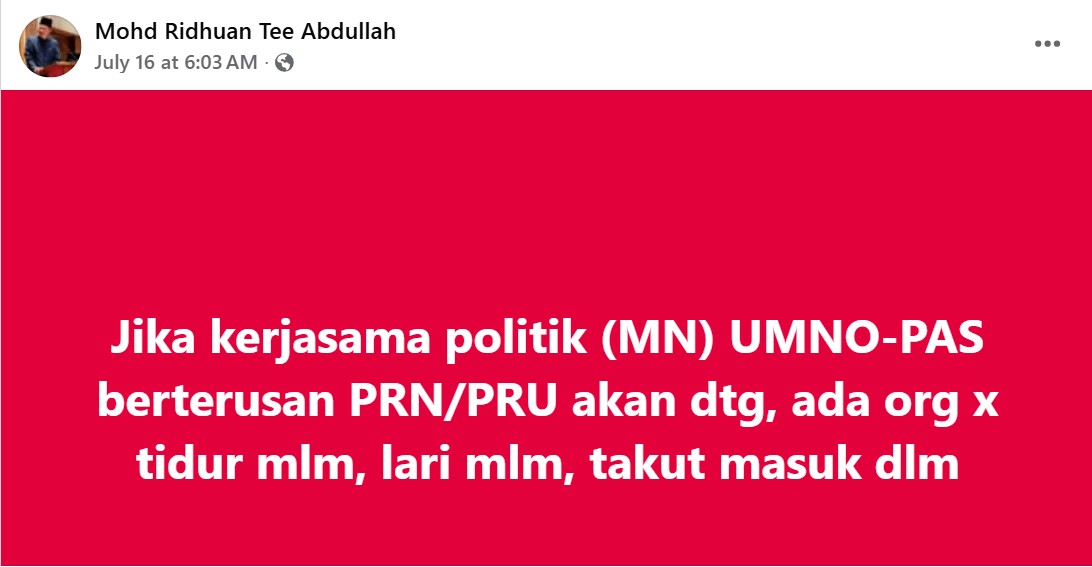
Thursday, 7:03 in the morning. A veiled threat aimed at critics of Perikatan Nasional. Eight thousand one hundred likes.
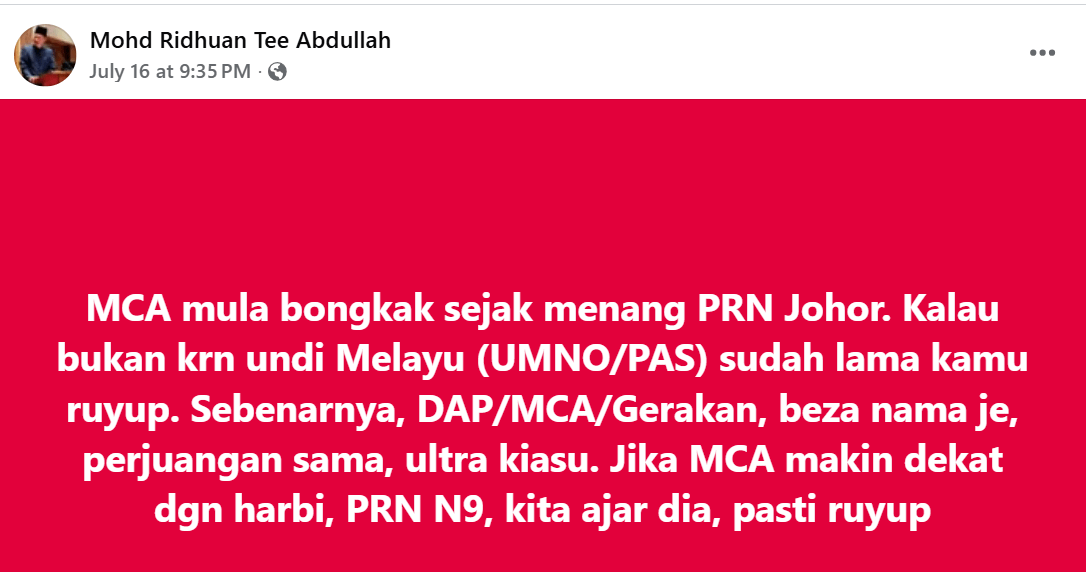
Thursday, 10:35 at night. The Malaysian Chinese Association, the Democratic Action Party, and Gerakan, flattened into a single phrase, “ultra kiasu,” and an electoral threat was attached. Sixteen thousand four hundred likes. Three parties with different histories, different constituencies, and a fifty-year record of fighting each other collapsed into one ethnic label because the label is the point, and the politics never were.
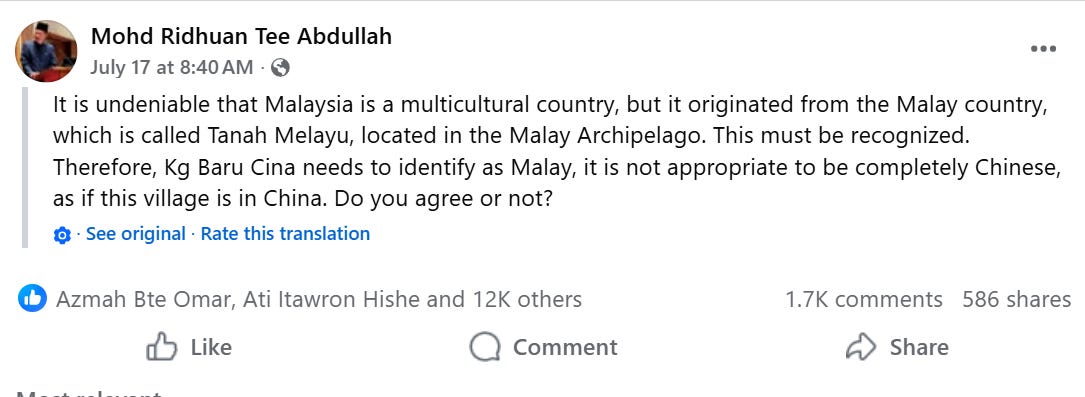
Friday, 9:40 in the morning. The Chinese New Villages should take on a Malay identity.
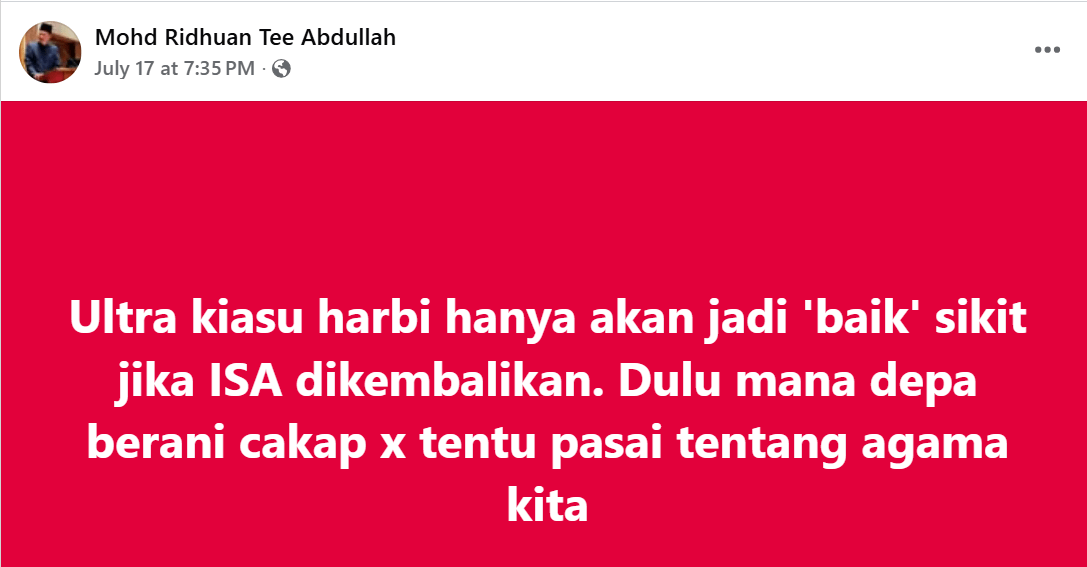
Friday, 8:35 at night. Bring back the Internal Security Act.
Thirty-seven hours, one direction, and the last stop is indefinite detention. The Rakyat Post reported the sequence on 19 July. The posts are public. The timing is not ambiguous: this landed in the window when a Negeri Sembilan electorate was two days from choosing candidates.
What he apologized for in 2015
In September 2015, in his own Sinar Harian column, Ridhuan Tee apologized for the Muslims who shouted “Cina babi (Chinese pigs)” at the Red Shirt rally. He wrote that he was “embarrassed” by the incident. He apologized “for the harsh words used by people who claim to be Muslims to the Chinese who are not ultra kiasu.”
Read that sentence again. The phrase was already there in 2015, doing the same work it does now: a qualifier separating the Chinese Malaysians he’d apologize to from those he wouldn’t. He has been sorting people into that box for at least eleven years.
Eleven years later, he is asking the state to hold their critics without trial.
The pattern is not political; it is reflexive
May 2026: the Rain Rave Water Music Festival. He called it a pesta maksiat and Malaysia a kafir illuminati state. The event was organized under a Muslim-led government. The New Straits Times reported that economic activity generated RM320 million.
April 2026: Thean Hock Keong canceled its Hari Raya open house, and he turned to Chinese temples and gambling.
March 2024: Qingming, ancestral graves, and a state assemblywoman told she was an immigrant.
A festival, a temple, a grave. There is no policy running through these. There is no legislative program, no argument about governance, no proposal. There is a reflex that fires at the same target every time, regardless of what the target was doing.
The part that should worry people who agree with him
Set aside your views on the Chinese Malaysian political parties. Set aside the Unified Examination Certificate, Dong Zong, vernacular schooling, all of it. Argue those on the merits, and people do, and they should.
None of that is what happened on Friday night.
What happened on Friday night is that a man with a decade of published output and a university listing asked for a law of indefinite detention to be restored and used against critics of a religion, forty-eight hours before an election. The bibliography is real. The post is real. Together, they describe someone who has stopped arguing and started requisitioning.
The Internal Security Act was not repealed because it was inconvenient to one community. It was repealed because a state that can hold anyone without charge eventually holds everyone without charge, and the people who cheer loudest when it comes back are never the ones who get to decide where it points next.
He wrote the book. The university indexed it. He apologized in 2015, and he is now asking for detention camps in 2026.
He has told you exactly who he is, in print, for eleven years, with a publisher and an ISBN.
Believe him.
KL Pundit is a scholar based in Malaysia. He writes on contemporary affairs, history, and politics.
Kindly explain the need to "hide" my response to the above article.