

Politicians across the whole political spectrum are disappointing citizens. From many citizens’ perspective Malaysian politicians time and time again have acted in self-interest over the public interest. The DAP could possibly be damaged beyond repair according to a DAP old timer. There are no peoples’ representatives in local government. They are all appointees.
With Malaysia’s media giving up its role as The Forth Estate and acting as government mouthpieces, with a few exceptions, the people have lost their voice.
There is talk once again for a third force in Malaysian politics. Before GE15 the third force approach was tried with MUDA purportedly representing the vote and Gerak Independent attempting to create a group of independent MPs to participate in government. Reformasi has failed and the social media-scape is under surveillance more than ever.
Its now time to look for workable alternatives that return a voice to the people.
Enter the Milk Tea Alliance
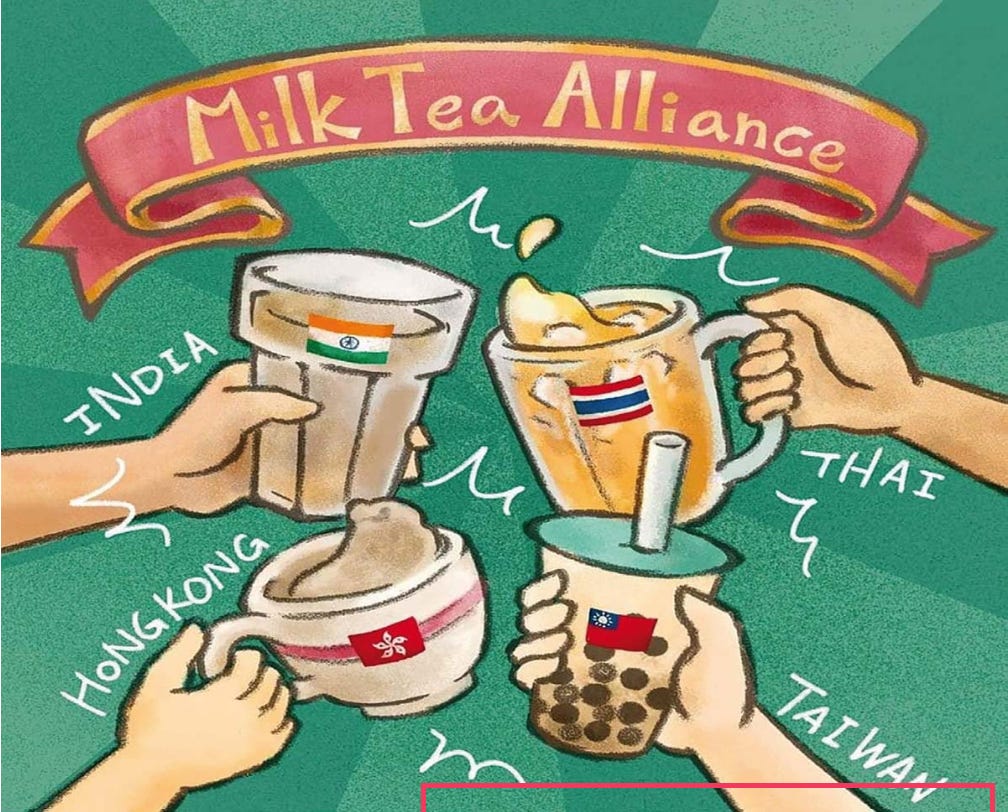
Over the last decade a diversified on-line movement has grown across Hong Kong, Thailand, Myanmar and now into Indonesia. This movement was inspired by pro-democracy protest movements in each place and has adopted symbols like the umbrella, three fingered salute of the “Hunger Games” in a common struggle against authoritarian rule. These movements converged to call themselves the Milk Tea Alliance, as each country drank milk tea.
The phrase “Milk Tea Alliance” originated as a hashtag in solidarity for those who took to the streets in Hong Kong in 2019 and spread to Thailand in 2020. This carried over to Myanmar in 2021 as the youth faced off on the streets with the military after the coup of 2021. There are now several new members including Indonesia, Taiwan and India.
A Leaderless movement
The Milk Tea Alliance is a leaderless movement so doesn’t get into the politics of power and ego, which plagues Malaysian politics today. The Milk Tea Alliance an online protest movement, and this suits Malaysians as its very difficult to physically protest in the country today.
Today the biggest issues are corruption and the losing the right of free of speech. These are apolitical issues so people from all sides of politics can participate. Today the corrupt judge themselves and freedom of speech is being removed quicker than most realize. In local government there is no discussion as decisions are made by faceless apparatchiks.
Today, its social media where opinions are given and political discussion takes place. WhatsApp and Telegram have become more reliable sources of ideas and opinion than the media. This is where any third force can begin. Any new movement must be nurtured naturally by the people, where natural leaders will eventually rise at some later time.
This is the only chance for political change in Malaysia. Reformasi and the spirit of the DAP over 60 years has been extinguished by greedy politicians. There will be no rise of any third force until a sound base has been created. The only way in Malaysia today is online.
Don’t forget, the early reformasi movement grew online during the early days of the internet.
Afterall Malaysians drink the Tarik #MilkTeaAlliance
Malaysia needs the Milk Tea Alliancce like China needs the Umbrella movement, the Thais need another red shirts yellow shirts movement, the Myanmarese need another Aung San Su Kyii and Malaysia another Bersih.
All of these movements had no local content, but a following created by social media content machines. None of them succeeded in what they claim they wanted because it was not what they wanted that created these movements. It is what the US wanted along with its 'deputy sheriff' John Howard in their quest for US hagemony in Asia.
All of those empty heads and big mouths like Ambiga Srinivasan, Lim Kit Siang and Hannah Yeoh's now languish under the shadow of Anwar Ibrahim, a man they underestimated along with the Neo cons of the US and the Soros Foundation.
The Milk Tea Alliance a Fraudlent Right Wing Chinese Disruptor:
The Milk Tea Alliance emerged in April 2020 as a "spontaneous" digital phenomenon on Twitter (now X), ignited by a controversy involving Thai actor Vachirawit Chivaaree (known as Bright). Chinese nationalists launched vehement online attacks against him for reposting content that appeared to acknowledge Hong Kong and Taiwan as distinct entities, contrary to Beijing's official stance.
In response, netizens from Thailand, Taiwan, and Hong Kong mobilized in his defense, forging a transnational bond rooted in shared cultural affinity for milk tea variants, Thai iced tea, Taiwanese bubble tea, and Hong Kong-style milk tea.
This symbolic beverage distinguished their regions from mainland China's traditional unsweetened teas, evolving into the hashtag #MilkTeaAlliance as an emblem of pan-Asian solidarity (which it is not- A right wing Chinese disruptor for their benefit it is) against perceived authoritarian overreach and digital aggression from Chinese nationalists.
Key Milestones in Its Formation
The Inciting Incident (April 2020): The backlash against Bright highlighted the extraterritorial reach of Chinese online nationalism, even on platforms restricted within China itself.
The Counter-Mobilization: Supporters from the affected regions coalesced in a spirited online rebuttal, transforming a celebrity dispute into a broader confrontation with state-aligned trolling.
Symbolic Consolidation: Milk tea became a potent metaphor for cultural kinship and resistance, birthing a decentralized movement advocating democratic principles.
Foundational Tenets
The Alliance embodies:
Transborder Digital Unity: Facilitating connections among activists confronting similar challenges to sovereignty and expression.
Commitment to Democracy and Autonomy: Championing self-determination and liberal governance.
Opposition to Authoritarianism: Critiquing expanding influence from Beijing and associated censorship practices.
Growth and Reach
From its tripartite origins, the movement rapidly broadened, incorporating pro-democracy voices from Myanmar (post-2021 coup), India (amid border tensions), the Philippines, and sporadically others such as Indonesia and Malaysia. It remains a leaderless, grassroots network, unified by common opposition to autocratic tendencies rather than formal structure.
Yet, for those seeking yet another cadre of fervent but ultimately ephemeral and unfocused figures, akin to Malaysia's Bersih movement, the Red and Yellow Shirts in Thailand, or even Aung San Suu Kyi, all of whom have faltered under sustained examination, the Milk Tea Alliance presents itself as a nebulous entity, ostensibly right-leaning in its orientation toward overseas Chinese networks, yet lacking coherent direction beyond advancing the interests of ethnic Chinese communities across the region.
Consider its purported endorsement of Anwar Ibrahim in Malaysia: proponents appear to have viewed him initially as a pliable figure, susceptible to influence, compromise, or even coercion through established channels in Malaysian politics. However, Prime Minister Anwar's resolute prioritization of indigenous Malay interests, particularly the rural and economically disadvantaged, has evidently been perceived as an act of disloyalty by certain quarters. This shift underscores his commendable dedication to national equity, achieved through perseverance and principled leadership.
Furthermore, the deliberate restraint on unfettered media expression, eschewing the Western paradigm of unrestrained publication regardless of consequences, has demonstrably contributed to stability and economic advancement in nations such as China, Singapore, Japan, and Taiwan. In this context, Anwar Ibrahim's reluctance to emulate Western liberal excesses in media policy aligns with a pragmatic path toward sustained prosperity, one that prioritizes societal cohesion over unchecked libertarianism. Why, then, should Malaysia now defer to external models that have yielded mixed outcomes at best?