
The Chartered Management Institute (CMI) and TVET qualification fraud
Geoffrey Williams and Murray Hunter
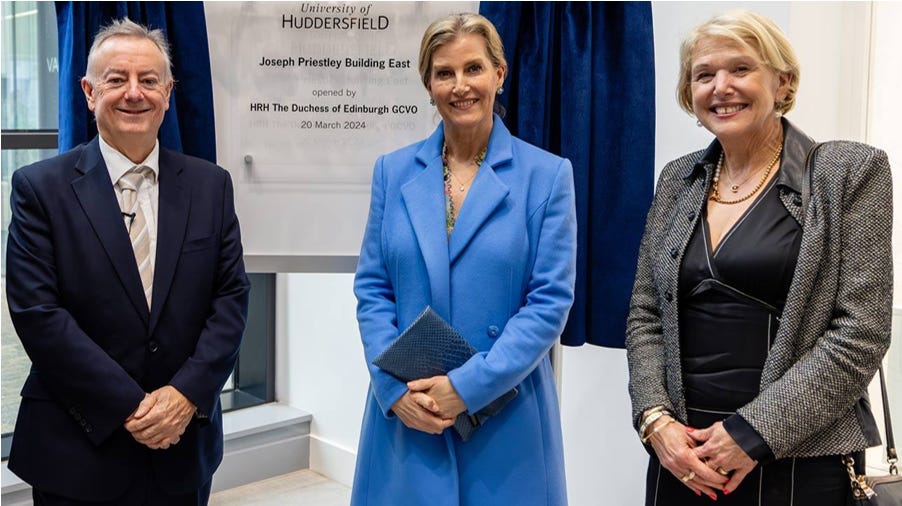
CMI Board of Trustees member and University of Huddersfield Vice-Chancellor, Professor Bob Cryan, CMI Royal Patron, Her Royal Highness The Duchess of Edinburg and CMI Chief Executive Ann Francke, (l-r) pictured together. Cryan and Francke face allegations of witness tampering in the Malaysian High Court were Francke also faces allegations of perjury.
The Chartered Management Institute (CMI) was born out of humble beginnings in technical, vocational education and training (TVET) and has continued to expand its commercial enterprises through TVET training overseas until today. CMI’s overseas training programmes through appointed commercial representatives and other ‘education’ organizations has escaped the scrutiny of British accreditation agencies and thus certificates issued through these commercial arrangements are in question.
Concerns about overseas accreditation have trigged 10 legal actions against CMI, including 3 civil actions, 2 perjury investigations against senior officers and investigations by statutory accreditation agencies.
Oddities in the “CMI Dual Accreditation Model”
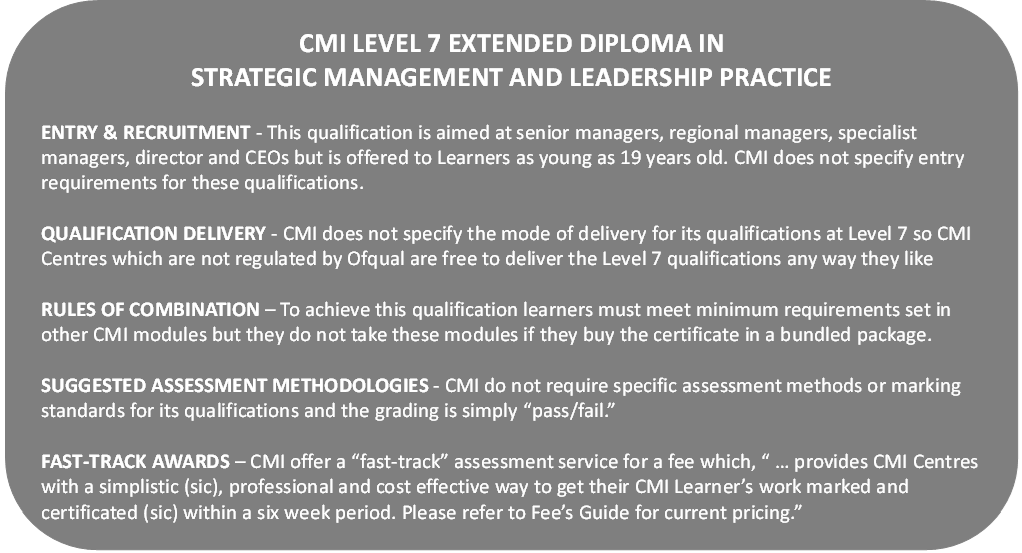
There are a number of oddities with CMI training models which render them unaccredited in countries outside the United Kingdom. An example is the widely available Ofqual accredited CMI level 7 extended diploma in strategic management and leadership practice.
When a TVET certificate is taken overseas in the “CMI Dual Accreditation” model it is packaged with a degree following various curricula and regulations which are not within the remit of regulators in the United Kingdom.
This makes each “Dual Accreditation” scheme certificate different to the one accredited by the UK regulating authority Ofqual. The condition of obtaining the certificate is the award of the degree rather than specific work and examinations in the TVET programme.
These issues render CMI certificates issued overseas unaccredited under Ofqual’s regulations and place them in breach of the Qfqual Action Plan for the Prevention of Qualification Fraud to which CMI is a signatory.
The “CMI Dual Accreditation” is a commercial arrangement in which overseas universities make a bulk purchase of certificates from CMI for which they pay a fixed fee. The certificates are then given to their own students by the overseas universities bundled in a package deal with their own degree certificates.
Under CMI contracts this sales model is mandatory. In many cases students cannot opt-out and they are often not aware that they are taking the course or have paid for the certificates. This practice is prohibited by Ofqual regulations.
The “Dual Accreditation” certificates cannot be obtained without the overseas university degree. To get the certificates through other routes the students must follow a separate prescribed course with classes, assignments and examinations from another CMI centre.
CMI qualifications sold overseas are only regulated by Ofqual if the same qualification is also sold to learners in England. The CMI “Dual Accreditation” packages sold with overseas partners are not sold in England. They are sold through overseas centres and Qfqual do not regulate these centres.
The entry requirements, course content, teaching methods, assignments, exams and overall course requirements are not set by CMI so each certificate they offer in a bundled package is unique to that product. This allows certificates with the same name to be vastly different depending on which partner offers the programme.
There are no entry requirements set down in the CMI certificate specification nor does it require any specific form of teaching or assessment. Learners do not take CMI classes, CMI assignments or additional CMI exams and their performance is not assessed on an individual basis by CMI.
Six-week, fast-track individual assessments for Level 7 (MBA degree equivalent) qualifications are available from CMI for a fee. The standard price is £55 per assessment or a “non-standard” fee of £105 for approval and £105 for marking per “non-standard” assignment.
Certificates similar to those described above are currently issued through CMI partners in 39 countries including Australia/New Zealand, the Middle East and South East Asia. There are at least 26 centres in the UAE alone and 21 private universities in offering the same in Malaysia.
Misuse of the Royal Charter
The Institute of Managers and Leaders Australian and New Zealand (IMLANZ) according to documentation has a ‘tie-up’ with the UK based CMI. The IMLANZ claims their Chartered Manager status is ‘recognized by Royal Charter’, which was issued to CMI in the UK back in 2002. Chartered Manager certificates have the CMI logo. This is a clear abuse of the Royal Charter granted to CMI in the UK.
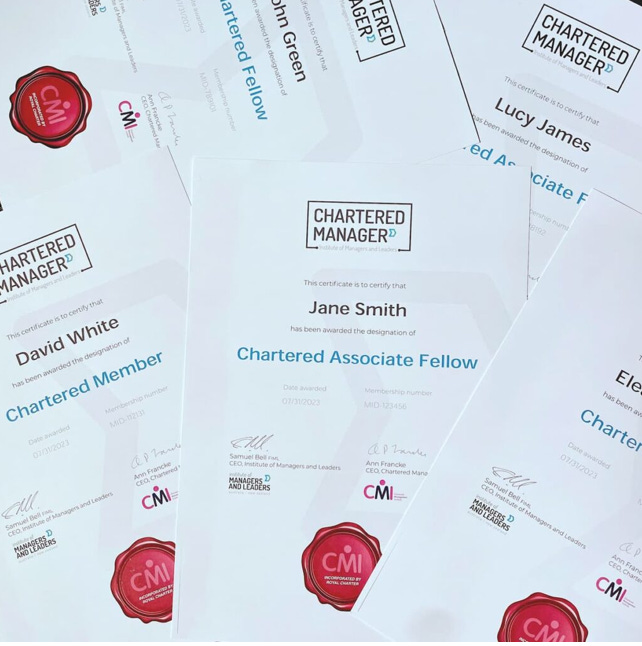
It is apparent that IMLANZ is also using this Royal Charter claim to issue Level 7 Strategic Leadership Certificate and access to the Chartered Manager designation. A similar arrangement exists with the Deakin University MBA.
Royal Charters are issued specifically to selected organizations and are not transferrable or franchisable.
Potential conflicts of interest
One of the main commercial partners for the CMI is Reed Business School part of the Reed Group a major provider of training and human resources consultancy around the world. Reed Business School offers a range of commercial CMI courses from Level 3 to Level 5 with fees as much as £1,600 per course.
The Reed Group also runs a platform on Reed Courses selling access to CMI certificates from other providers and a training arm called Reed Learning also offering CMI certificates on commercial terms.
The Chairman and CEO of Reed Group is James Reed who is also the President-elect of CMI. While there is no suggestion of his involvement in any wrongdoing prior to his appointment at CMI his new role might raise questions of a potential financial and commercial conflict of interest under the Qfqual regulations and potentially under the CMI Royal Charter.
These are issues James Reed would be well-advised to address when he assumes office as CMI President.
Sounds very much like the degree factories of the UK and Australia. One scandal after another. A five minute chat with many a lawyer from Malaysia who graduated from the UK will convince you that most of the law degrees from the UK are not worth the paper they are written on.