
Three issues that politics cannot solve in Malaysia
Feudalism, the deep (administrative) state, and ‘communist style’ economics

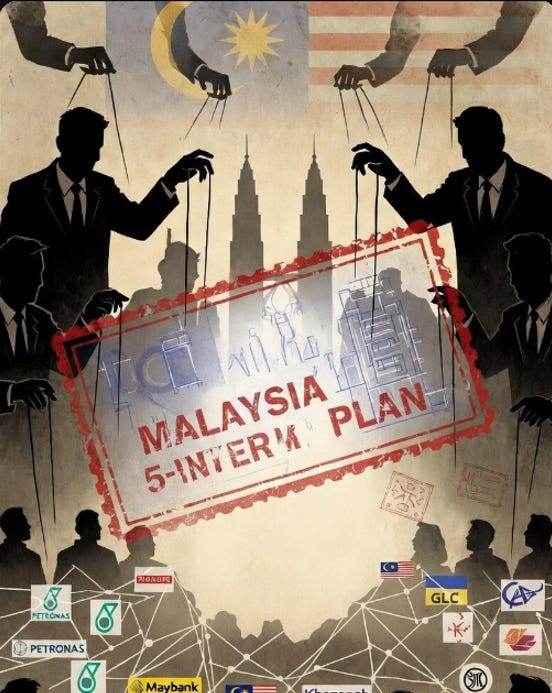
Malaysia has now been a nation for 62 years. The country has a pseudo-democracy as described in the Malaysian Constitution that the British primarily created. Since Merdeka or independence three distinct features have developed which now form the bedrock of the nation. First, Malaysia is a feudalistic country which has not disappeared over development. Feudalism is an important part of today’s society where rituals and artefacts exist everywhere. Second, a deep (or administrative) state has developed within the nation that remains totally intact even when there are changes in government. It could be argued that the deep state has more influence upon day-to-day governance than the political-executive part of government. Finally, Malaysia chose very early on to run its economy with 5-year plans and set up government owned corporations (GLCs) to control many strategically important industries. These stretch from oil & gas, communications, and banking. The Malaysian economy is very highly regulated in a manner that does not reflect a market economy. This highly regulated system, with GLCs accounting for over 50% of Bursa Malaysia’s market capitalization in key areas, deviates significantly from free-market principles and echoes elements of centrally-planned economies which primarily exist exclusively in communist nations.
These entrenched issues—feudalism, the deep state, and a quasi-planned economy—defy resolution through conventional politics alone, as they are woven into the fabric of institutions, culture, and power dynamics.
Feudalism in Malaysia: A Persistent Legacy
Feudalism in Malaysia, far from being a historical artifact, endures as a “psychological feudalism” or “neo-feudalism,” as coined by sociologist Syed Hussein Alatas. Rooted in pre-colonial Malay sultanates, it manifests in hierarchical social structures, patronage systems, and deference to authority that permeate modern governance and society.
This continuity fosters a culture where loyalty to elites who are most often tied to political parties like UMNO destroys meritocracy, reinforcing ethnic privileges under concepts like Ketuanan Melayu (Malay supremacy). In politics, this translates to cronyism, where titles, rituals, and networks sustain power imbalances, stifling multiculturalism, and innovation.
There are many examples of where feudalism has influenced policy. The New Economic Policy (NEP) inadvertently entrenched neo-feudal hierarchies through patronage, creating a divide between the elite and masses.
In daily life, feudal norms appear in blind obedience to leaders, suppressing dissent and critical thinking. Malaysia has the highest power-distance rating in the world. Power distance is the extent to which less powerful members of a society or organization accept and expect that power is distributed unequally. Thus, Malaysia within society and the civil service is excessively patriarchal.
This embedded mindset resists reform, as political changes rarely dismantle the cultural structure built on feudalism. Even post-2018 shifts failed to erode these attitudes, which Alatas warned could persist for generations.
Politics alone cannot solve this; it requires societal transformation beyond elections, challenging ingrained values that view hierarchy as natural.
The Deep State in Malaysia: Bureaucratic Shadows
Malaysia’s deep (or administrative) state refers to an entrenched bureaucracy and institutions that exert influence beyond elected governments, often through institutional inertia rather than outright conspiracy.
With 1.7 million civil servants which has a ratio of 4.3% to the population, this apparatus, heavily Islamized and Malay-dominated, resists reforms, prioritizing ethnoreligious hegemony and patronage.
Originating from colonial and BN-era structures, it includes surveillance by bodies like Special Branch, infiltrating civil society, unions, and even royal households. The Sedition laws protect many elements of the deep state.
There are many claims that the deep state hindered the Pakatan Harapan government between 2018-2020. Key tactics in hindering the government included foot-dragging, leaks, and blocking policies counter to entrenched interests.
The civil service’s ethnic quotas have eroded meritocracy, fostering corruption and inefficiency. Networks like “school ties” amplify this, enabling covert alliances. It elements within the deep state which is not homogenous where corruption evolves and operates.
The deep state outlasts regimes, as evidenced by stalled reforms under Anwar Ibrahim.
Politics cannot dismantle this; it demands structural overhaul of hiring, accountability, and depoliticization, transcending electoral cycles.
Communist-Style Economics in Malaysia: Planned and State-Dominated
Malaysia’s economy, while capitalist in name, exhibits “communist-style” elements through centralized five-year plans (Malaysia Plans) and dominant government-linked companies (GLCs), echoing Soviet planning legacies.
Introduced post-independence, these plans guide resource allocation, subsidies, and protections, with GLCs controlling key sectors like finance, telecoms, and energy.
GLICs like Khazanah and Permodalan Nasional Berhad (PNB) oversee vast holdings, often prioritizing Bumiputera equity over market efficiency.
This state intervention, rooted in the New Economic Policy, has fostered patronage, with GLCs crowding out private enterprise and enabling cronyism.
Critics argue it deviates from free markets, with pyramid ownership structures and affirmative actions which have been instrumental in concentrating wealth. Most planning is undertaken within a top-down mode, which has little regard for the communities it is intended to serve.
Recent calls to retire these plans highlight their outdated nature in a globalized world.
Yet, they persist, as in the 13th Malaysia Plan (2026-2030), blending Madani ideals with top-down control.
Politics fails here; entrenched interests in GLCs and plans resist liberalization, requiring a paradigm shift to rules-based markets over state fiat.
The recent unjustified price rise in non-subsidized RON95 petrol for profit taking is an example of the excesses of such a ‘communist style’ economy.
The deep state is a product of feudalism and the ‘communist style’ central planning is used to embed cronies within protected industries. Such a structure promotes ‘rent-seeking’ at the cost of innovation. Politicians and governments are very much irrelevant to this structure and in-essence ‘serve’ serve the elite patriarchy.
Malaysia will never be able to economically diversify and progress at the same rate as its neighbors under such a national framework. No government will be able to reform this structure.
This is the reality of Malaysia.
Murray Hunter’s opening remarks in this article go beyond mere mischief; they reveal a decidedly skewed perspective on Malaysia and its system of government. He describes the country as possessing “a pseudo-democracy as described in the Malaysian Constitution that the British primarily created.” Yet nowhere in the Federal Constitution does such a phrase appear. Even if one were to accept the label, one might fairly ask what, precisely, constitutes a democracy in the first place. A tyranny like that the US suffers from today?
Consider, by way of contrast, Australia, a nation that long denied its Indigenous peoples the most basic recognition of humanity. It was not until 1971, under Prime Minister Gough Whitlam, that modest rights were extended to Aboriginal Australians; full retrospective acknowledgment came only in the 1990s with the landmark Mabo decision, which overturned the fiction of terra nullius. If Murray Hunter wishes to lecture others on democratic purity, he might first reflect on that history. He can be forgiven by being confused as to what 'democracy' really means or to find a universal definition for it coming from Australia.
He then turns his attention to Malay cultural traditions and institutions, portraying them as impediments to progress. He speaks, too, of a “deep state” that supposedly dominates governance: “a deep (or administrative) state has developed within the nation that remains totally intact even when there are changes in government… [with] more influence upon day-to-day governance than the political-executive part of government.”
Here, one suspects a certain looseness with terminology. The concept of a “deep state,” as understood in American discourse, bears little resemblance to the Malaysian reality Hunter depicts. What he describes is simply the permanent civil service, entrenched by law, largely insulated from political turnover, and answerable ultimately to legislation and the Constitution. That arrangement is hardly exotic; it mirrors precisely the British model from which Malaysia’s own constitutional framework was drawn.
Equally unconvincing is his portrayal of Malaysia’s economy, its free-market orientation, five-year planning cycles, and the prominent role of government-linked companies on the stock exchange, as akin to the centrally planned systems of old. One might note, in passing, that China today operates with far greater market flexibility than many European economies or even the United States, yet Hunter’s comparison lingers stubbornly in an earlier era.
The pattern continues. Beneath the surface of these critiques lies something more pointed: a veiled animus toward Malays and Muslims that echoes a broader Western reflex. It is an attitude that finds occasional echo among the wider body of Malaysian Chinese voices, though one wonders whether they fully grasp how thoroughly such destabilisation would ultimately injure their own position. Murray Hunter, it seems, speaks with a forked tongue, his words ostensibly analytical, its undertone far less so. Shame ! Xenophobia by any other name and rising its ugly head in Australia once more in the name of 'Nationalism".
Alloy or Arrangement: Two Divergent National Experiments
Few neighbouring countries illustrate contrasting nation-building philosophies more clearly than Singapore and Malaysia.
Both began with similar raw materials: multiethnic populations, colonial legacies, fragile social cohesion, and uncertain futures. Both inherited diversity not as a choice, but as fact. Yet they chose different methods of managing it.
Singapore chose to become an alloy.
Malaysia chose, instead, an arrangement.
An alloy is not the denial of difference. It is the fusion of difference under common pressure. Singapore’s civic framework — competitive education, common national service, race-neutral economic positioning in global markets — was built on the premise that survival required maximising talent across all communities. The organising principle was meritocratic participation within shared institutions. Identity was recognised, but citizenship was paramount.
The underlying wager was bold: that equality of rules, not equality of outcomes, would produce cohesion. That pressure would forge unity rather than fracture it.
Malaysia adopted a different wager. After the trauma of racial unrest in 1969, its political architecture increasingly embedded communal balancing into state policy. Opportunity, access, and advancement were structured with ethnic considerations in mind, especially in favour of the Malay majority under affirmative frameworks. The intention was stability — to correct historic imbalances and prevent future conflict.
But stability through allocation differs fundamentally from strength through integration.
Where Singapore sought to fuse its elements into a competitive composite, Malaysia institutionalised communal compartments. The former placed citizens into a common arena; the latter maintained differentiated lanes within it.
This divergence carries consequences.
A civic-meritocratic system generates relentless internal competition. It is unforgiving. It risks inequality and social stress. But it channels ambition toward productivity. Talent is treated as a national asset, not a communal one. The global marketplace becomes the ultimate referee.
A communally structured system, by contrast, moderates competition through protection. It prioritises social equilibrium over pure efficiency. It may reduce immediate friction between groups. Yet over time, the cost of insulation becomes visible. When identity conditions access, merit becomes negotiable. When protection becomes permanent, adaptation slows.
The question is not moral condemnation. It is structural sustainability.
In a globalised century, capital, technology, and expertise are mobile. Investors do not price ethnicity; they price efficiency. Innovation does not ask which community produced it; it asks whether it works.
The world rewards alloys.
This is not to deny Malaysia’s achievements, nor to romanticise Singapore’s model. Singapore’s meritocracy has its own criticisms — elitism, intense academic stratification, pressure-cooker competition. Malaysia’s communal policies arose from real historical wounds and genuine concerns about imbalance.
But the philosophical divide remains stark:
Singapore defines citizenship first and ethnicity second.
Malaysia, institutionally, has often defined ethnicity first and citizenship through it.
One model says: compete together.
The other says: develop alongside.
One believes integration produces resilience.
The other believes differentiation preserves harmony.
History will judge which approach proves more adaptable in the long run.
The deeper issue transcends both countries. It asks a broader question of all plural societies:
Can a modern nation afford to organise itself around ethnic hierarchy — even benevolently framed — in an age where competitive advantage determines survival?
An alloy endures because its elements are inseparable once fused.
An arrangement endures only so long as its compartments hold.
The future will test which structure is more resistant to corrosion.